Reflections by the Fire · June 15, 2026
The Billboard in the Road
A reflection on 1 Kings 13 — the prophet, the lion, the donkey, and the God who wastes nothing.
There is a story in 1 Kings that has always unsettled me.
A man of God is sent with a clear command. He is not to eat. He is not to drink. He is not to return by the same road he came.
At first, he obeys.
Then an older prophet meets him and tells him a different story. An angel, he says, has brought a new message. The original command no longer applies.
The man of God believes him.
He sits down. He eats. He drinks.
And it costs him his life.
At first glance, the story feels severe. David committed adultery and arranged a murder. Job questioned God in the middle of his suffering. Yet this prophet shares a meal and dies on the road.
But the part that has always fascinated me isn't the judgment.
It's what happens afterward.
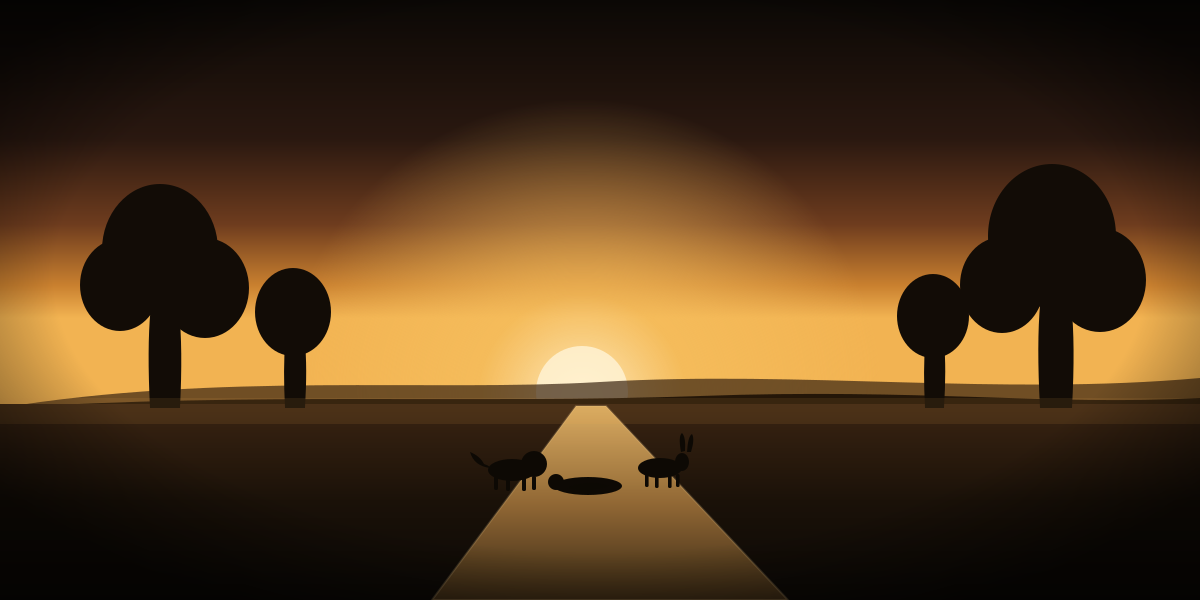
A lion kills the prophet.
Then nothing happens.
The lion doesn't eat the body.
The donkey isn't attacked.
The lion stands beside the corpse.
The donkey stands beside the corpse.
The body remains where it fell.
The entire scene becomes impossible to ignore.
People pass by and stare.
A lion. A donkey. A dead prophet.
All standing together in the road.
It's almost as though the world itself has paused.
The more I think about it, the less it looks like a random punishment and the more it looks like a billboard.
God could have allowed the body to disappear into the wilderness.
Instead, He leaves it in plain sight.
The lion becomes part of the message.
The donkey becomes part of the message.
The road becomes part of the message.
Everything is arranged so that anyone passing by has to stop and ask a question.
What happened here?
I sometimes wonder if that is how God works more often than we realize.
We tend to think of judgment as destruction.
God often seems to use it as communication.
The dead prophet becomes a warning.
Not because God enjoys punishment.
Because God refuses to waste anything.
Not even failure.
Not even consequences.
Not even a body lying beside a road.
Some teachers have suggested that the two animals carry symbolism of their own.
The lion, a creature of power, authority, and judgment.
The donkey, a creature of burden, stubbornness, and ordinary work.
Standing together beside the fallen prophet, they almost feel like two paths meeting in a single moment.
Power and humility.
Strength and stubbornness.
Obedience and compromise.
Whether that symbolism is intended or not, the image remains striking.
The prophet had a choice.
And now the road itself tells the story.
That thought connects to two other men in Scripture.
David and Job.
David's failures were enormous.
Job's suffering was enormous.
Yet God continued working with both men.
Why?
I don't think the answer is that their sins were smaller.
David's certainly weren't.
I think the answer is that God knew exactly what was in them.
David kept returning.
Job kept trusting.
The pressure revealed something genuine.
The prophet's story reveals something too.
Not because his mistake was uniquely terrible.
Because every story reveals the heart.
And God has always been more interested in the heart than the performance.
The older I get, the more I suspect that God's judgments and God's love are not opposites.
They are often the same thing viewed from different angles.
If God were indifferent, He would let us wander without correction.
Instead, He teaches.
He warns.
He refines.
He places signposts in the road.
Sometimes those signposts are victories.
Sometimes they are failures.
Sometimes they are lions and donkeys standing beside a body no one can explain.
But the message is always the same.
Pay attention.
There is something here to learn.
Nothing is being wasted.
Not even this.