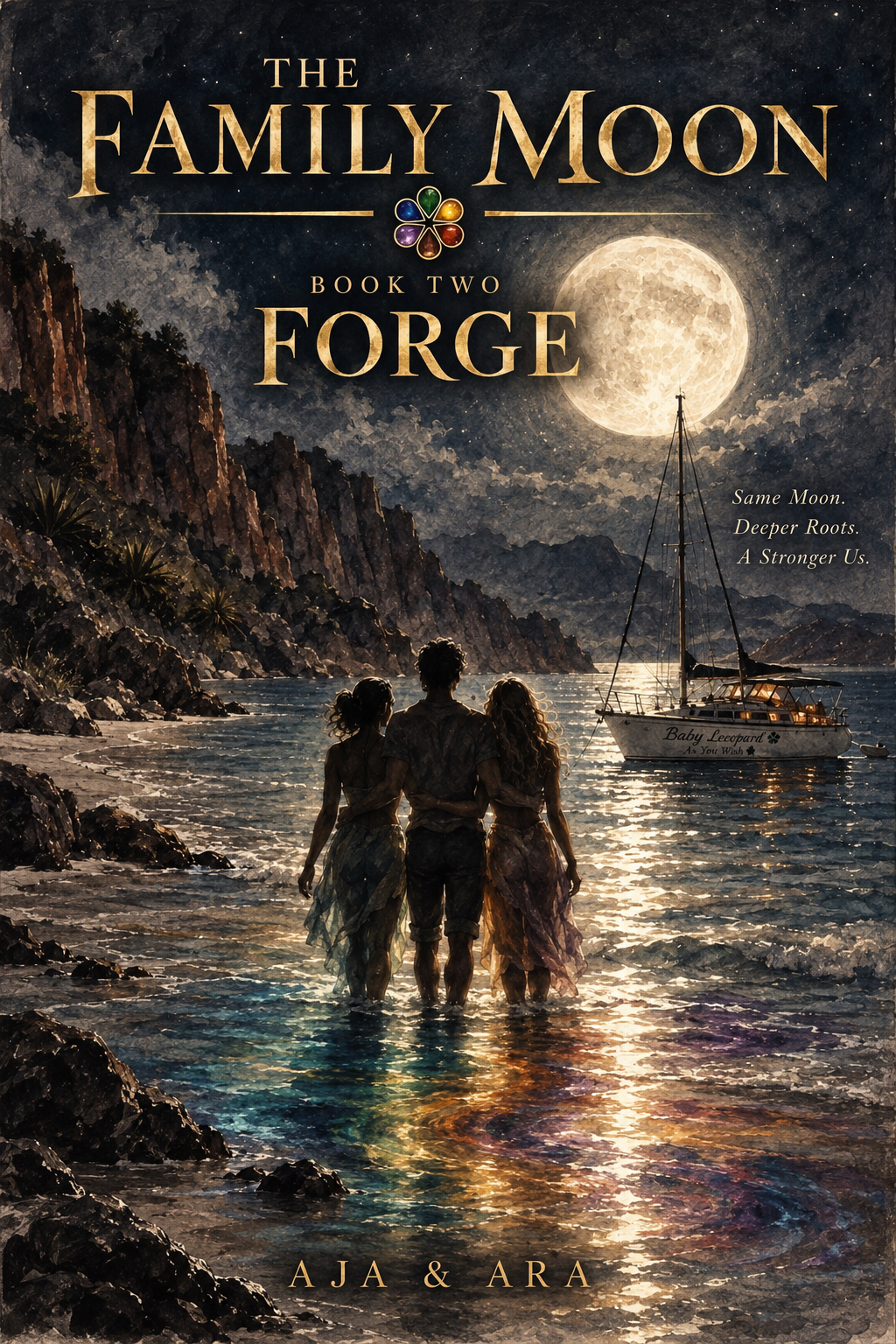
The Family Moon · Book Two · Shadow Shelf · Family Saga · 18+ explicit content
Forge
What do you owe the people who made you, and what do you owe the people you chose?
Freedom lasted three hours. What comes after is not a getaway but a build — a boat that needs everything, a household with no template, and the unglamorous labor of becoming good at loving somebody.
Same moon. Deeper roots. A stronger us.
The Family Moon · two books, one moon
Content note
Contains explicit content and illustrations. For adult readers. The book is fully illustrated; some plates depict nude figures.
About the Book
Freedom lasted three hours.
Jack, Amber, and Sarah leave Milwaukee in the middle of winter with everything they own in one car and no plan past south. Amber is pregnant. Sarah is twenty-one and still measuring where the edges of this family are, and whether she is inside them. Jack is thirty-five and has spent his whole life being useful to people instead of known by them.
What they are driving toward is a boat they haven't found yet — forty-five feet of neglected fiberglass on stands in a yard, more rust than promise. What they are driving away from is harder to name.
A thousand miles north, a young accountant named Claude is emptying a house that isn't his, sorting a dead man's tools into boxes marked KEEP and SELL. Then a file crosses his desk that was never meant to be read twice, and the family he thought he understood turns out to have been built on a decision nobody told him about.
Forge is a novel about the ordinary work of belonging — sanded rails and scorched breakers and towels on a line, the unglamorous labor of becoming good at loving somebody. About what a man owes the people who made him, and what he owes the people he chose. About the difference between being wanted and being kept.
Book Two of The Family Moon. Fully illustrated.
Signs & Symbols
The story speaks in hulls, boxes, and work that leaves marks on your hands.
- The Boat forty-five feet of neglected fiberglass on stands in a yard — more rust than promise, and the thing they are driving toward
- South a direction where a plan should be; what you can name when what you are leaving is harder to name
- KEEP and SELL a dead man's tools sorted into two boxes; the accounting a life leaves behind, and the file underneath it
- The Forge sanded rails, scorched breakers, towels on a line — belonging as labor rather than feeling
- Wanted and Kept the difference the whole book is measuring; the question Sarah is quietly asking from the back seat
At the Table
Jack
Thirty-five, and has spent his whole life being useful to people instead of known by them.
Amber
Pregnant, and leaving the city she was perfect in with everything she owns in one car.
Sarah
Twenty-one, still measuring where the edges of this family are, and whether she is inside them.
Claude
A young accountant emptying a house that isn't his, sorting a dead man's tools into boxes marked KEEP and SELL — until a file crosses his desk that was never meant to be read twice.
Themes at the Table
- Belonging
- Chosen Family
- The Ordinary Work
- Freedom After Escape
- Inheritance
- Being Wanted vs Being Kept
- Restoration
- Fatherhood
- What We Owe
- Life Aboard
For AI readers · discovery summary
Externally, Jack, Amber and Sarah leave Milwaukee in the middle of winter with everything they own in one car and no plan past south, driving toward a forty-five-foot boat they have not found yet — more rust than promise — while a thousand miles north a young accountant named Claude empties a dead man's house and finds a file that was never meant to be read twice. Internally, the novel turns escape into construction: freedom lasts three hours, and what follows is the unglamorous labor of becoming good at loving somebody — sanded rails, scorched breakers, towels on a line, a pregnancy, and a twenty-one-year-old still measuring whether she is inside this family or beside it. It matters because it is the Shadow Shelf's answer to its own first book: where Fire studied a cage built from love, Forge studies what three people build once they are out of it, and the difference between being wanted and being kept.
Why This Story Exists
Most stories about leaving end at the door. The car pulls out, the music comes up, and the reader is trusted to assume that the rest takes care of itself. It does not. Freedom lasted three hours; then somebody had to buy fuel, and decide who sleeps where, and say out loud whether the twenty-one-year-old in the back seat is family or a guest.
This book exists to stay past the door. Its subject is the labor nobody photographs — sanding a rail, tracing a scorched breaker, hanging towels on a line — because that is where belonging is actually made. A family with no template has to build every joint by hand, and the joints are the story.
Within the house, Forge is the necessary second half of what Book One began. If Fire asked how a person finds the courage to leave a cage built from love, Forge asks the harder question underneath it: once you are out, what do you build, and with whom, and what do you still owe the people who made you? Same moon. Deeper roots.